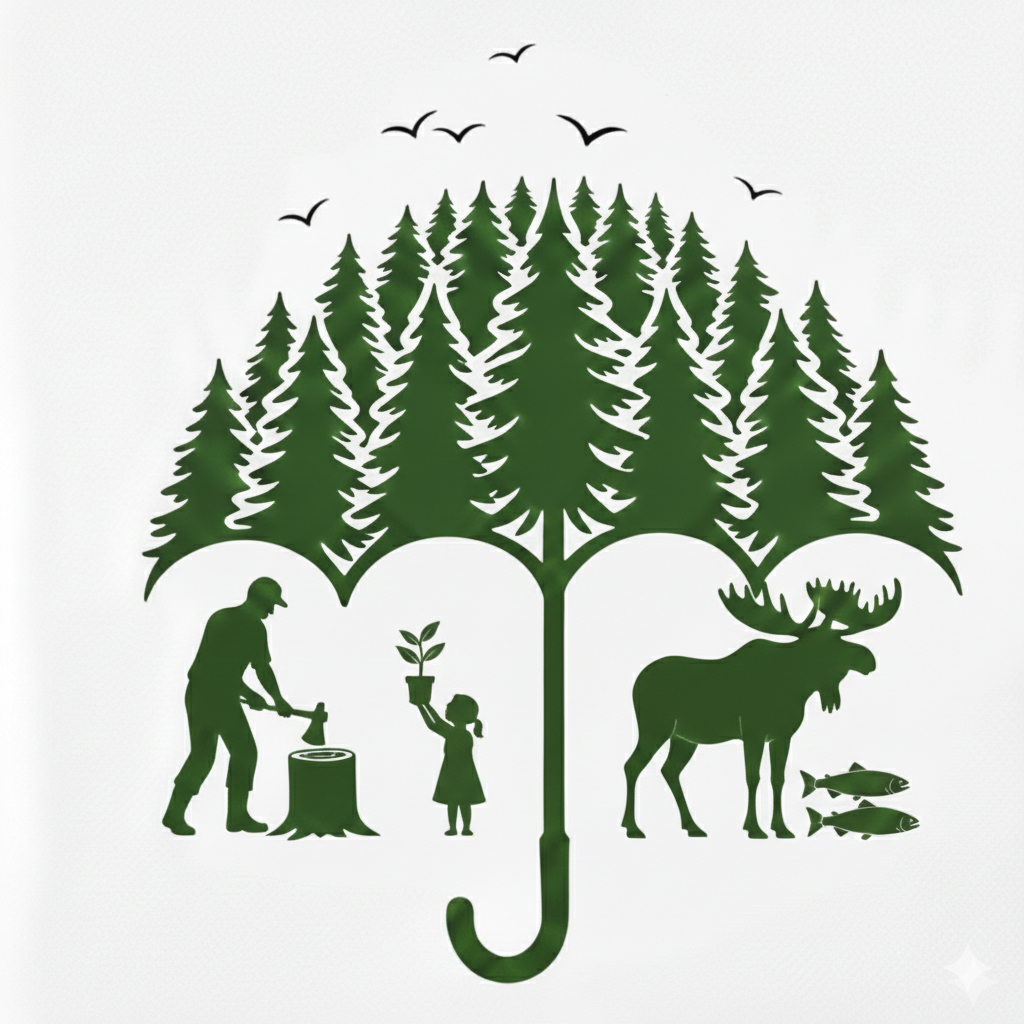
The Umbrella
We realize as custodians of the forest for now and for future generations, it is not all about us. So as a guide to the challenges and pathway forward, we present a story here through the eyes of a large forest hawk, a Goshawk whom we have named Gus. Gus relies on an intact healthy forest ecosystem and was once common throughout BC; she is our canary in our forest, and we are on the brink of losing her. We hope her story can provide the change in direction to forest management that will support both Gus and those working in the forest. A change that will both allow us to be part of a healthy ecosystem now, and to ensure that the Beautiful Forests of BC are also part of our children’s future.
The logo of the tree shaped like an umbrella represents the structure needed by many species, like Gus, that depend completely and partially on mature and Old Growth forests, for their survival. Without this structure, they will disappear over time from our forested landscapes.
The numbers tagged in the logo represent the connection between the Mature and Old Growth forests and the outline of the table of contents or the 5 acts. That tragedy is a story about the loss of the Americal Goshawk called Gus that is currently unfolding in a number of landscapes in the Skeena-Stikine Region and throughout BC.
All 5 Acts represent the basic structure of a Shakespearian Tragedy. I have grouped all the work we have done into these 5 Acts and surves admirably as a table of contents. I hope you enjoy the long read.
Act 1 is about the struggle Gus has with our current forest management policy and legislation,
Act 2 includes the 25+ years of collected ground field data and initial Timber Supply Analysis and Best Management Practises,
Act 3 has what we have learned about indifference to successfully manage Gus,
Act 4 opens up the challenges with our approach and getting our message out and finally,
Act 5 suggests some novel yet practical approaches to resolving a number of public and governmental issues dealing with Old Growth forests, flood and fire risk and climate mitigation.
This tragedy is written for the general public in the hope that the public [common] good, from a ecosystem health and long term timber supply approach, becomes a more open discussion that results in positive changes to better manage our priceless forest ecosystem and wildlife services and values.